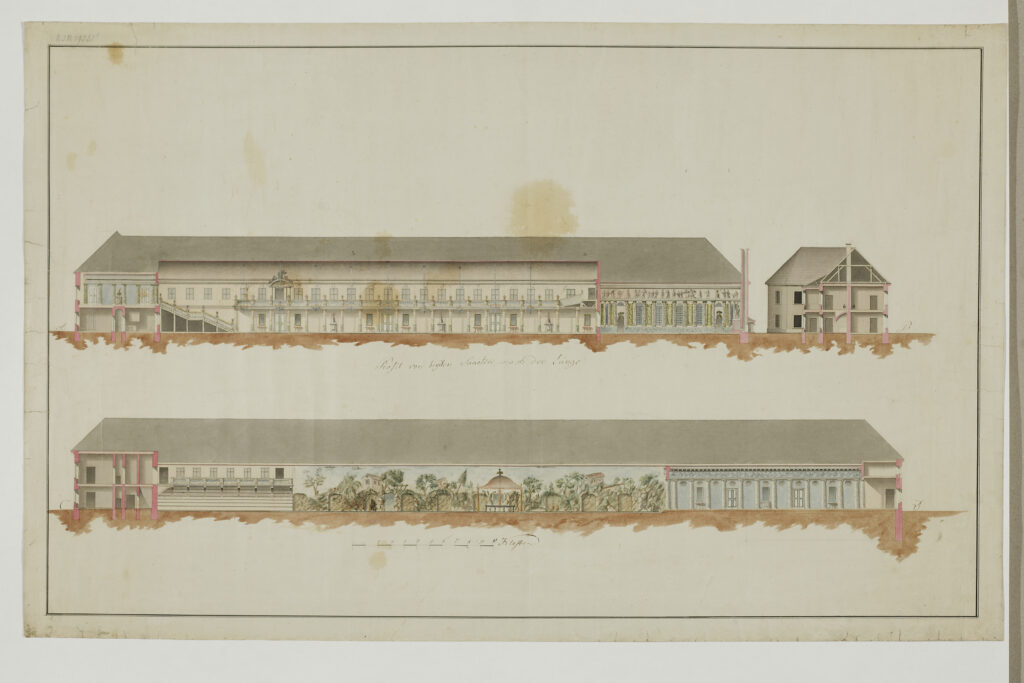
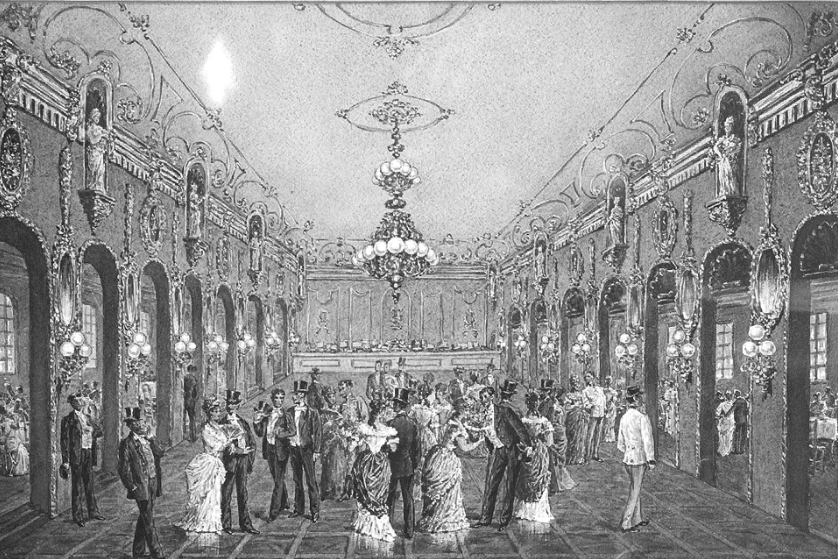
The Apollosaal on Schottenfeld was an opulently furnished entertainment establishment in 19th century Vienna. Anyone who crossed the threshold of the location was drawn into the spell of the magnificent rooms – complete with marble columns, artificial ponds, waterfalls and real trees. All this shone in the glow of thousands of candles, while the Viennese turned to the music in a waltzing rhythm. (Full text on ORF Topos)
Wenzel Deimel (Stadtbaumeister), Etablissement Apollosaal in der Zieglergasse, Schnitt durch die beiden Säle, 1819, Wien Museum Inv.-Nr. 19351/3, CC0 (https://sammlung.wienmuseum.at/objekt/152223/)
Zum Großen Zeisig
The restaurant “Zum großen Zeisig” (today: 7., Burggasse 2) was a popular dance and folk singing venue in the 19th century. The house “Zum großen Zeisig”, located on Spittelberg at the Burg-Glacis, was built in 1698 by the court trellis-maker Fabian Fritz, who sold it in 1711 to the innkeeper and carter Mathias Zeissel. During the battles in 1809 the house was severely damaged, then rebuilt and provided with a large hall. The inn established there actually carried the sign “Zum goldenen Adler”. (German full text)
In 19th century Vienna, the enjoyment of music was not reserved for the elite educated bourgeoisie. Rather, a diverse music scene existed in the public sphere. Bands played in the parks and gardens, and beggar musicians provided acoustic background music in the backyards. Barrel organ players were part of the street scene – and even provided orchestral music thanks to their instruments. (Full text on ORF Topos)
“I was born on the first of March 1865 in Hernals near Vienna as the son of a simple craftsman,” the Viennese zither teacher Eduard Johann Nikl (1865-1922) formulated autobiographically. Nikl was “descended from Sudeten Germans” on his father’s side and “from a Waldviertel farming family” on his mother’s. “Intended by his parents to be a sculptor” (Eduard Nikl himself describes the profession as “wood sculpting”), he “broke away” from this profession due to “poor business” and turned to the zither.
Sound sample of the “Wiener Zitherfreunde”, Stück Nr. 11.
“Wirthausmusik” (Pub music)
Katharina Pecher-Havers
Around 1800, Franz Anton de Paula Gaheis described the suburb of Neulerchenfeld (today part of Vienna’s 16th district) as “the largest tavern in the Holy Roman Empire”. Of the 155 houses, 83 possessed “Schankgerechtigkeit.” 16,000 people from the city would have sought recreation there on a Sunday. The frequency of visits to the innumerable taverns in the suburbs increased even more from 1829, when the Linienwall (today’s Gürtel) was declared a customs border. Due to the consumption tax that had to be paid, food and drink inside the “Lina” were more expensive, which is why the Viennese population migrated to the suburbs for consumption on Sundays and holidays.
The New Dreher Beer Hall (Neue Dreher’sche Bierhalle) in Vienna’s third district not only offered a popular concert venue for well-known Viennese bands, it also provided the stage for the premier performances of the New Vienna Women’s Orchestra (Neue Wiener Damen-Orchester). This group of eight female musicians was led by violinist, conductor and pianist, Josephine Weinlich.In 1859, a dignified inn designed by Anton Dreher the elder (1810—1863) was located at Landstraßer Hauptstraße 97—101. Situated on the former site of two smaller buildings, including the inn Zur grünen Weintraube, Dreher’s inn boasted a large open-air restaurant and dance hall which could host 3,000 patrons. (Full text)
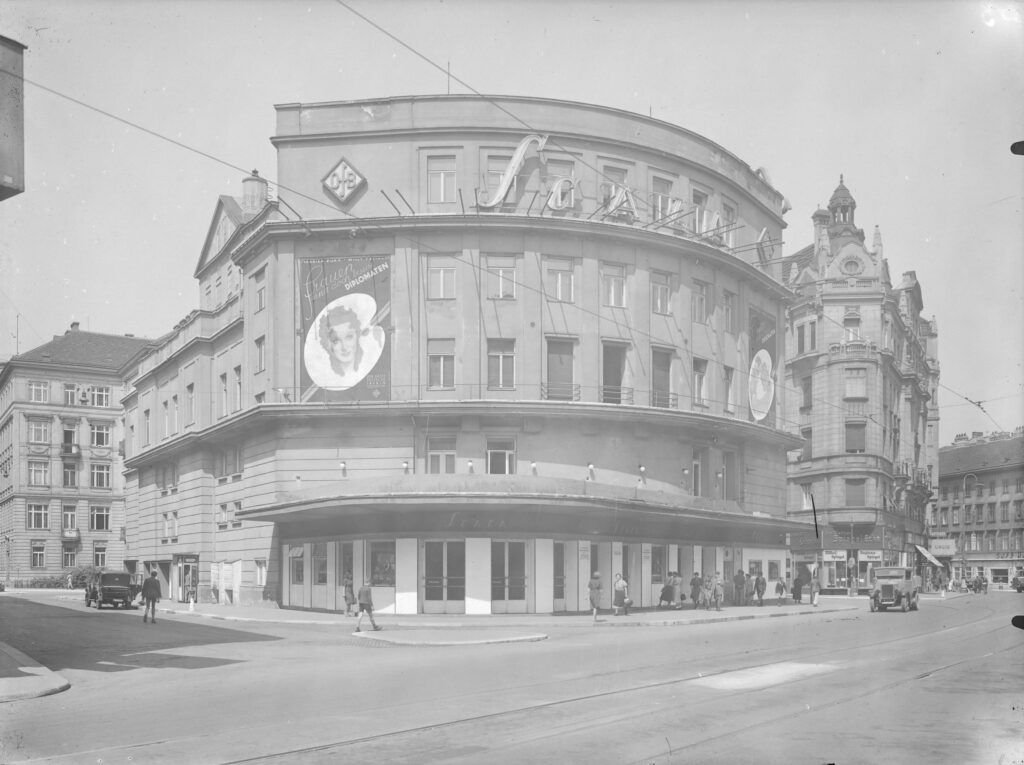
Vienna Wieden was once home to the Johann Strauss Theater, whose eventful history leads through just five decades and from the operetta temple to the Scala Theater. Even Josephine Baker once performed here with her revue. Most recently, the theater became a stage for political plays of left-wing orientation and staged, for example, the controversial Berthold Brecht in Vienna. (Full text)
Martin Gerlach jun. (Fotograf), Scala-Theater (4., Favoritenstraße 8), Außenansicht, um 1938–1940, Wien Museum Inv.-Nr. 211332, CC0 (https://sammlung.wienmuseum.at/objekt/26699/)
Isabella Sommer
Zum Schwarzen Bock
“Zum schwarzen Bock” was the name of a popular inn and entertainment venue on Wieden (today: 4th, Margaretenstraße 27). The inn had existed since 1700 and experienced a boom after 1800, as good dance orchestras always performed there; in the 1840s it lost its importance. In April 1820, the innkeeper Josef Weishappel announced that he had taken over the “well-known hall Zum schwarzen Bock on the Wieden, redecorated it and provided it with a parquet floor” and that the dance hall was connected to the guest garden for the convenience of the guests. (German full text)
Vienna of the 19th century offered first class musical variety and with it made the Strauss family superstars. This is also where the globalization of the waltz began to go viral. Dances became major events; entertainment became a spectacle. Though the social contrasts were great, mainstream character and escapism dominated popular culture offerings. (Full text on ORF Topos)
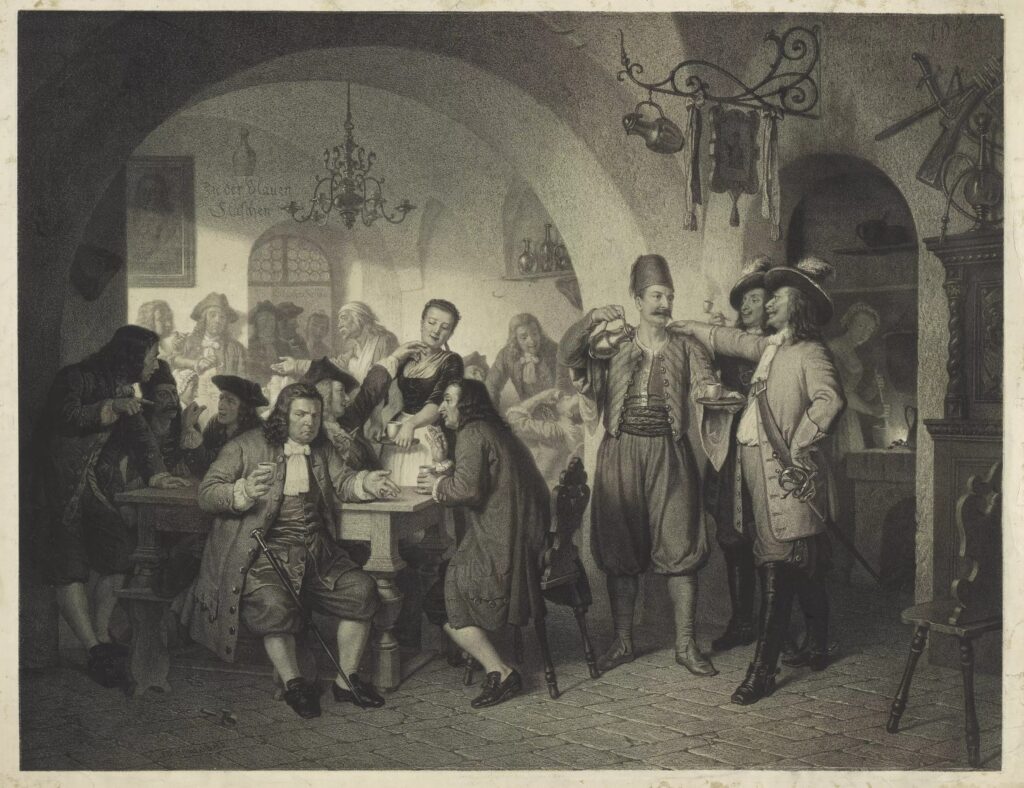
The eventful year 1848 brought a bourgeois revolution to Vienna. Johann Strausssenior and junior were involved on both sides musically, but for one Strauss hisinvolvement was, meanwhile, quite momentous. A piece of musical history was(presumably) written the Blue Bottle Inn (Gasthaus Zur Blauen Flasche) in thedistrict of Ottakring. Interestingly, caterwauling (Katzenmusik) played acacophonous supporting role in all of this. (Full text on ORF Topos)
Franz Schams (Lithograf), Franz Schams (Künstler), “Das erste (Kulćzyčki’sche) Kaffeehaus in Wien, 1684 / Vom oesterreichischen Kunstvereine in Wien, 1862” – Darstellung des vermeintlich “ersten”, der Legende nach von Georg Franz Kolschitzky betriebenen Wiener Kaffeehauses (“Zur blauen Flasche”), 1862, Wien Museum Inv.-Nr. 47913, CC0 (https://sammlung.wienmuseum.at/objekt/428262/)
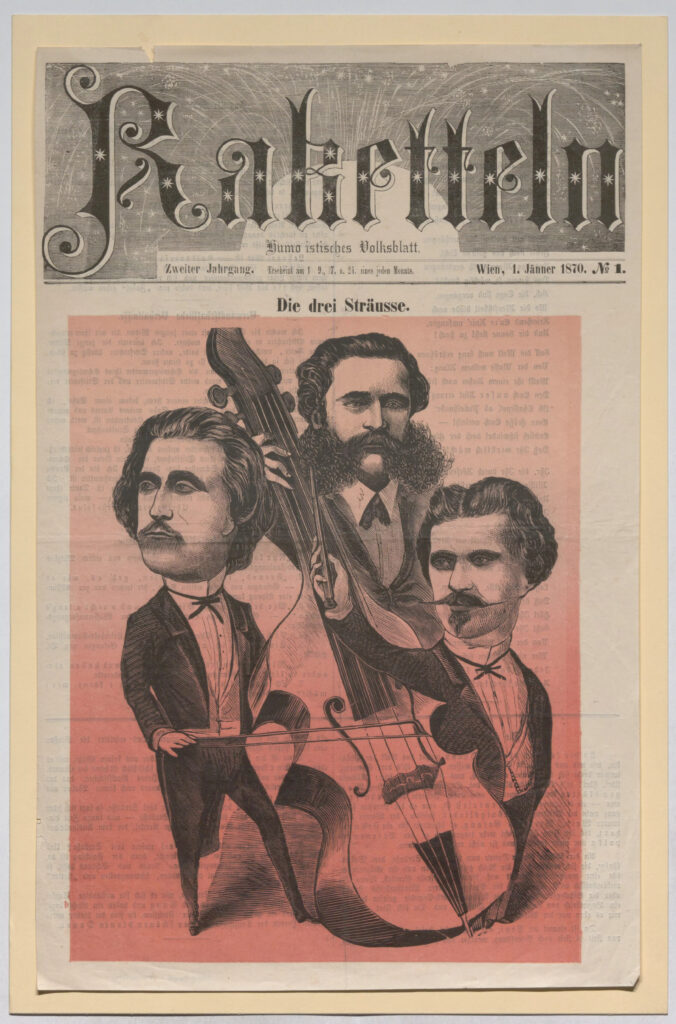
The Vienna of the 19th century produced a tremendous variety of music. To this day, however, one name in particular is associated with it: The Strauss family of musicians shaped Vienna’s music and entertainment culture for decades. Johann Strauss and his sons, above all Johann Strauss Son, became the first superstars of the international music business. Including extensive world tours and groupies in crowds. (Full text on ORF Topos)
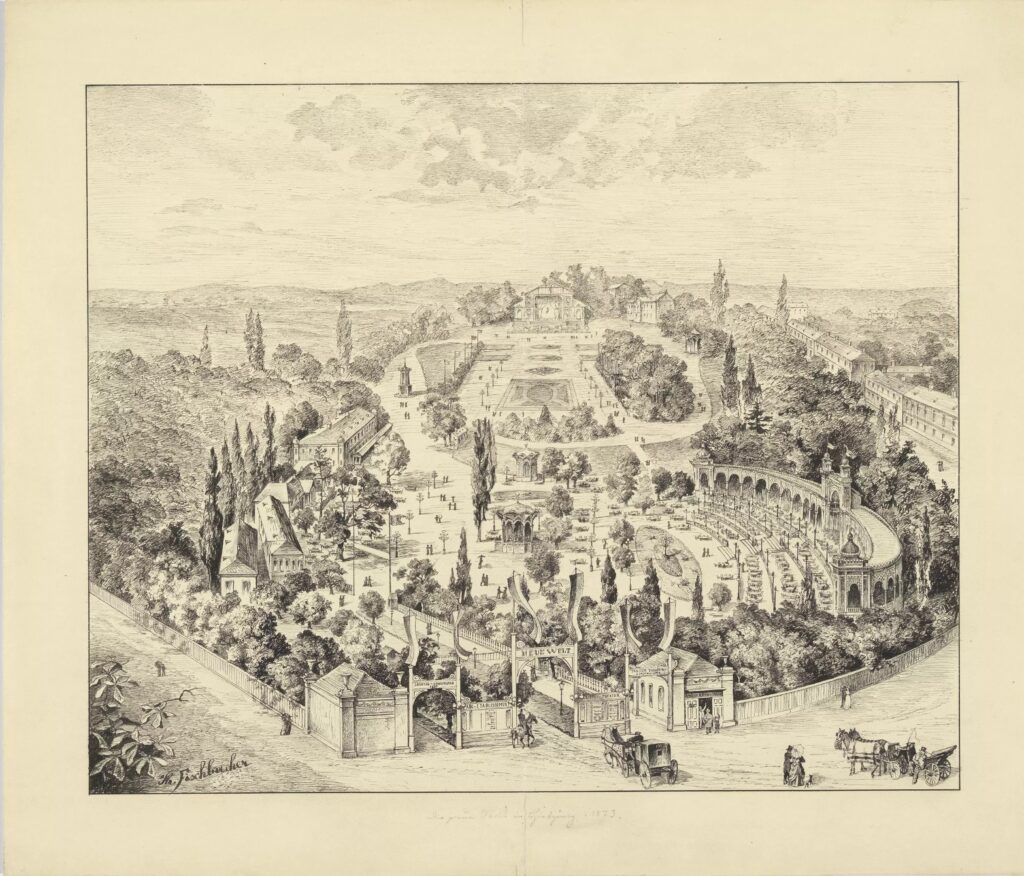
With his dance halls and coffee houses, Carl Schwender was one of the most successful developers during the Biedermeier era. His most spectacular enterprise was undoubtedly the “New World” (Neue Welt) amusement park. Thousands of Viennese flocked to Vienna’s thirteenth district of Hietzing to listen to the lively waltzes of the Strauss brothers, for example. Sometimes these two even come in a pair to the New World. (Full text on ORF Topos)
In Biedermeier times, the pleasure of dancing also attracted the Viennese to the suburbs. Thus the Sperlsaal in the then suburban Leopoldstadt became one of the most popular entertainment establishments. Here, elegant Vienna spins to the most lively waltzes. waltz sounds. Especially for Johann Strauss’s father, “der Sperl” became his favorite pub. And the first stage for a large number of his works. (German full text on ORF Topos)
Dancing hall „Zum Sperlbauer“ – Photographie after Lithographie by G. Zafourek.
Wagners Kaffeehaus
Wagner’s coffeehouse in the Prater (Hauptallee No. 9, formerly No. 18), also called the “Second Coffeehouse was very popular, especially because of the musical entertainment it offered. popularity. It was built around 1786 and in 1799 Franz Anton de Paula Gaheis described it as larger and more distinguished than the “First Coffee House” in the Prater. From 1802 Ignaz Wagner his daughter Antonie was a friend of Ferdinand Raimund. (German full text)
Quite closely tied to Johann Strauss senior, this restaurant, which is one of the earlier entertainment venues of Vienna, was named after the first chain bridge urban infrastructure of the city. It opened for business on October 1 1825, three days before the opening of Vienna’s first chain bridge or Kettenbrücke (then named the Sophienbrücke, today: Rotundenbrücke) (German full text)
The Diana Hall was built at the beginning of the century on the model of a Roman thermal bath and with a first-of its-kind iron roof structure. In 1840, it was transformed into the predominantly covered swim spa in Europe. For economic reasons, it was refitted and turned into a ballroom and concert hall, gaining prominence in the 1860s. (German full text)
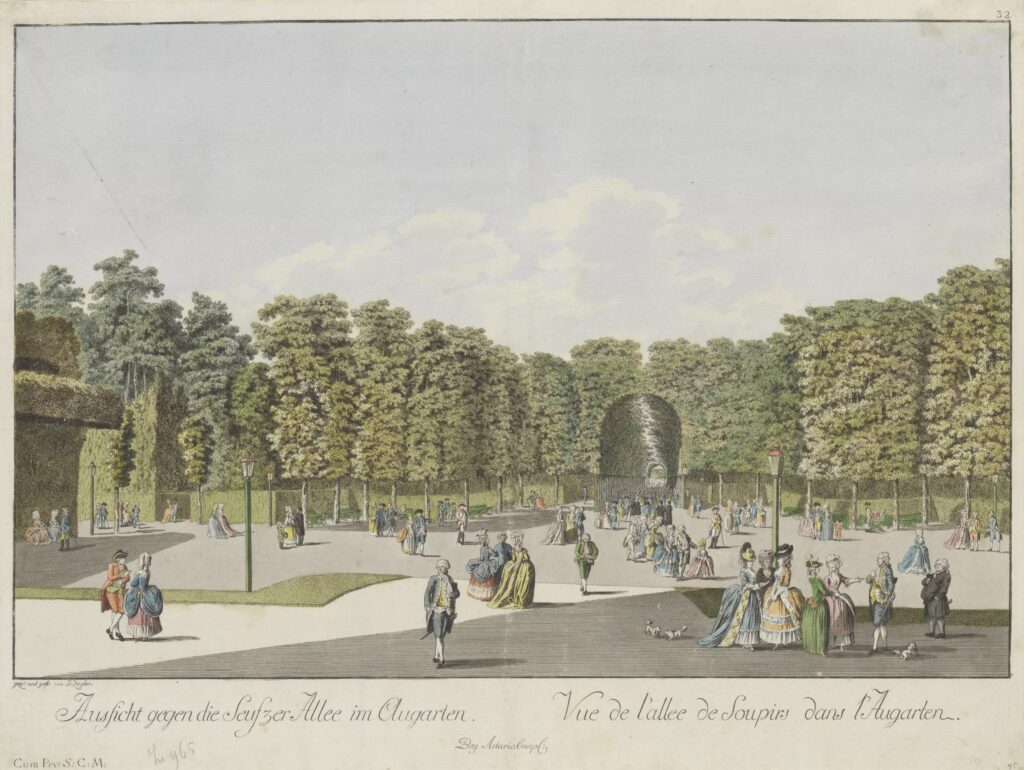
The Augarten (today: Obere Augartenstraße 1) – 52.2 hectares in size and one of the oldest and most most important baroque gardens in the city – was originally reserved for the imperial family as a hunting ground and recreation area. Joseph II made the 30.4.1775 the Augarten was opened to the general public. From this year dates the entrance portal, designed by Isidor Canevale, dates from this year. words can be read: “Place of amusement dedicated to all people by their cherisher.” (German full text)
Johann Andreas Ziegler (Artist), Artaria & Co. Verlag (Verlag), “Aussicht gegen die Seufzer Allee im Augarten” / “Vue de l´allee de Soupirs dans l´Augarten” (1. Etat), um 1783, Wien Museum Inv.-Nr. 18985, CC0 (https://sammlung.wienmuseum.at/objekt/144885/)
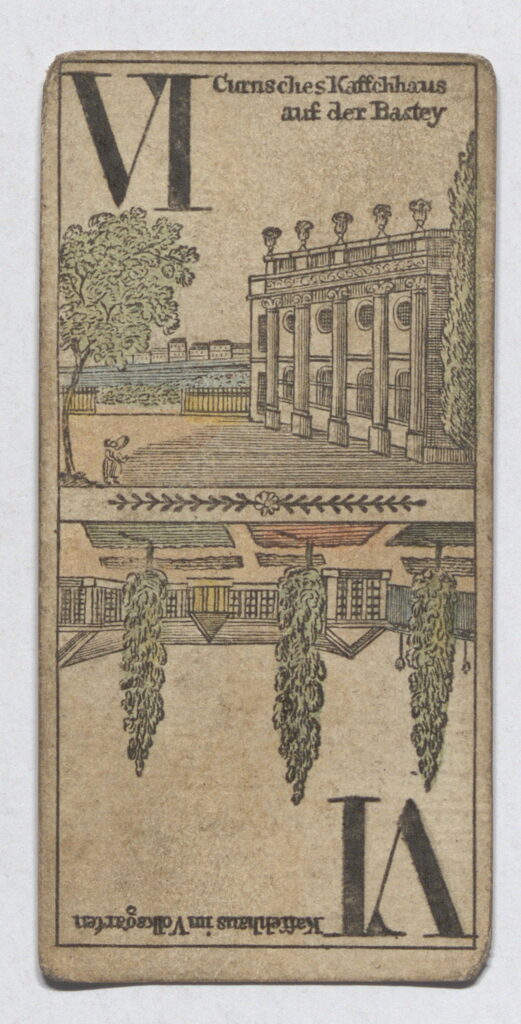
Around 1820, the “Cortische Kaffeehaus” in the People’s Garden (Volksgarten) was a particularly popular café frequented by aristocracy and bourgeoisie. The location also became a gathering place for the, so to say, hipster scene of the time. One reason for its great appeal was the popular dance music performed by Joseph Lanner and Johann Strauss senior and junior, among others. Consequently, the establishment became the stage for many a musical premiere. (German full text on ORF Topos)
Unbekannt, Tarock-Kartenspiel mit Ansichten von Wien und Umgebung – Tarock 6: Kaffeehaus im Volksgarten / Curtisches [Cortisches] Kaffeehaus auf der Bastei, 1840, Wien Museum Inv.-Nr. 57064/6, CC0 (https://sammlung.wienmuseum.at/objekt/129577/)
The “Daum´sches Elysium”
Manfred Permoser
As a typical representative of the aspiring bourgeoisie, Joseph Georg Daum made his mark on Viennese social life during the Biedermeier period. As the son of a wealthy grocer, Daum soon demonstrated his entrepreneurial skills. After purchasing the former café ‘Milani’ on Kohlmarkt, he generously remodeled the establishment and in 1830 opened the Daum’sche Kaffeehaus, a luxuriously appointed establishment that soon became a popular meeting place for the aristocracy and high military. (German full text)
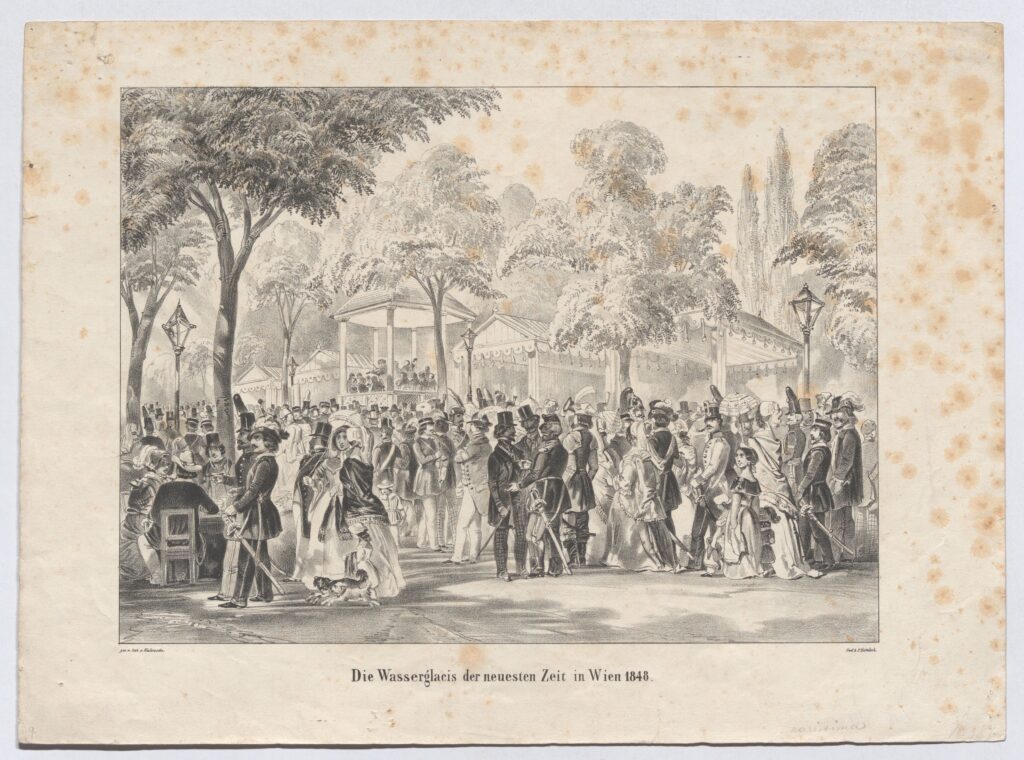
The Wasserglacis was a popular recreation and amusement place on the site of the later built horticultural building and the opposite city park 1st district. “Glacis” was the name given to the meadow areas outside the city fortifications, which were not allowed to be built on for strategic reasons. In 1770, Josef II ordered the beautification of the glacis; driveways and sidewalks were laid out and trees were planted. (German full text)
Franz Kaliwoda (Lithograf), Johann Höfelich (Drucker), “Die Wasserglacis der neuesten Zeit in Wien 1848.”, 1848, Wien Museum Inv.-Nr. 87605, CC0 (https://sammlung.wienmuseum.at/objekt/834/)